
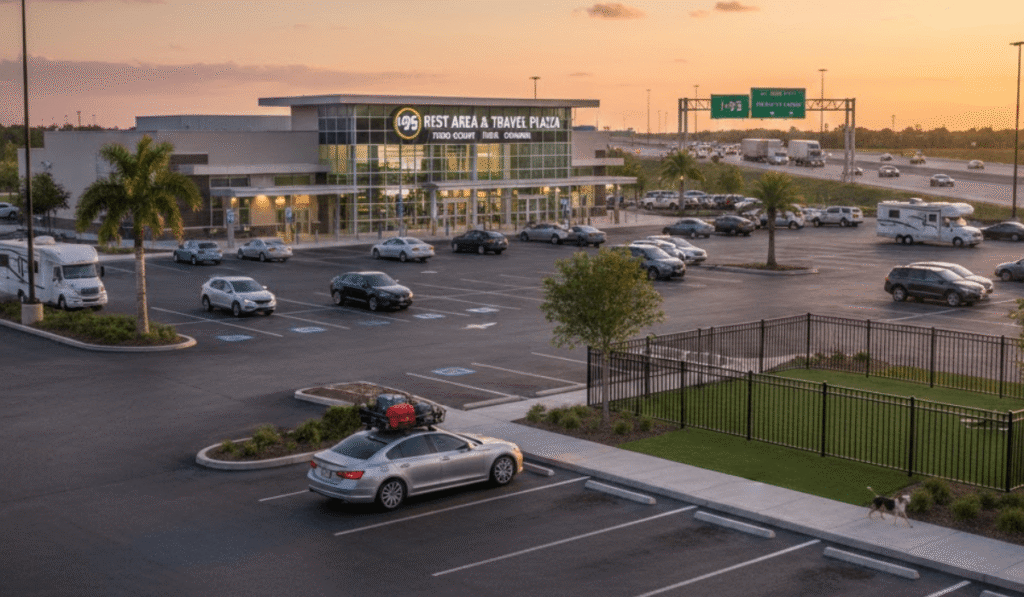
If you’ve ever driven I-95, you already know it’s no ordinary highway. Stretching nearly 1,900 miles from the tip of Florida all the way to the Canadian border in Maine, it passes through 15 states and some of the most densely trafficked corridors in the country. Whether you’re doing a weekend getaway to the Outer Banks or a full East Coast migration, knowing where the rest stops are on I-95 is essential planning, not optional. Here’s what you need to know.
The Florida Stretch: Mile 1 to Mile 382
Florida’s section of I-95 runs from Miami north to the Georgia state line. The Florida DOT maintains a solid network of rest areas along this stretch, and the welcome center just north of the Florida-Georgia border is genuinely one of the nicest in the country — free orange juice included, which never gets old.
Key stops include the Port St. Lucie rest area, which offers pet areas and clean facilities, and several well-maintained stops through the Jacksonville corridor. Florida rest areas are generally open 24 hours and have vending machines, making them reliable overnight stops too.
Georgia, South Carolina, and North Carolina
Once you cross into Georgia, the rest areas thin out a bit, so plan accordingly. The Savannah area has good options, but gaps between stops can stretch 60 to 80 miles in some sections. South Carolina is similar — a smaller state with fewer but generally clean and well-stocked rest areas.
North Carolina picks things back up nicely. Rest areas along I-95 here are spacious, have pet walks, and some have been recently renovated. The welcome center at the South Carolina border heading north is worth a stop for the maps and travel guides alone.
Virginia, Maryland, and Delaware
Virginia’s I-95 corridor is one of the busier stretches on the entire East Coast, and the state has invested in making rest areas match that traffic. You’ll find multiple full-service stops between Richmond and the DC area, several with family restrooms, nursing rooms, and vending.
Maryland has fewer traditional rest areas on I-95 and instead relies more on service plazas — think Maryland House and Chesapeake House — which have full food courts, gas, and retail. Delaware has limited options, but the state is so small that you’re usually through it before it becomes an issue.
New Jersey, New York, and New England
New Jersey’s I-95 runs through the New Jersey Turnpike, which is peppered with service areas every 20 to 30 miles. These are full-service restaurants, fuel, restrooms — so you’ll never be stuck. New York’s stretch is brief but managed similarly.
Connecticut, Rhode Island, and Massachusetts all have decent rest area coverage, though some facilities are older. Maine’s welcome center at the southern border, right after you cross from New Hampshire, is a great final stop if you’re heading up to Vacationland.
Tips for Driving the Full I-95 Corridor
Space your stops every 100 to 150 miles at most. With 15 states on this route, rules and facilities change frequently, so downloading an app like iExit before you go gives you real-time info on what’s ahead.
For the most up-to-date rest area locations, closures, and amenity details on I-95, visit restareasnearme.com and plug in your route before you leave. A little prep goes a long way on a drive this long.