
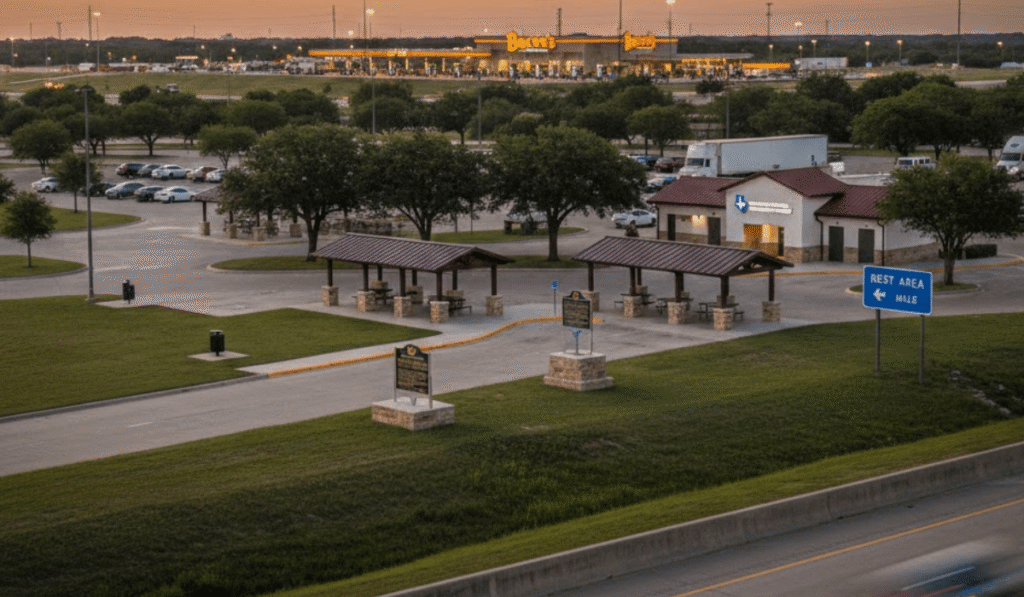
Texas is not a state you casually drive through. It’s enormous — over 800 miles from El Paso to Beaumont, and nearly as far north to south. Driving across Texas isn’t a detour; it’s a commitment. The good news is that TxDOT — the Texas Department of Transportation — maintains one of the most robust rest area systems in the country, and the state has some genuinely great stops. Plus, there’s Buc-ee’s. We’ll get to Buc-ee’s. Here’s your guide to surviving and enjoying the long haul across the Lone Star State.
What Makes Texas Rest Areas Unique
Texas takes pride in its rest areas in a way that reflects the state’s general approach to doing things — bigger and better. Many Texas rest areas are large, well-maintained facilities with covered picnic areas, which matters enormously in a state where summer temperatures regularly hit 100 degrees and above. Shade isn’t a luxury here; it’s a necessity.
Texas also posts historical markers and exhibits at many rest areas celebrating the state’s heritage. You might stop for a bathroom break and end up reading about the Chisholm Trail or a famous Texas battle. It’s a quirky touch that makes a routine stop genuinely interesting.
Most Texas rest areas are open 24 hours, staffed during the day, and have pet walk areas. The facilities are generally clean, and TxDOT takes maintenance seriously on the major corridors.
I-10: The Southern Transcontinental
I-10 is the longest interstate in Texas, running from El Paso all the way to the Louisiana border — over 880 miles entirely within the state. This is the road trip marathon of Texas driving, and rest area planning is not optional.
The stretch from El Paso east through the Permian Basin is the most remote. Rest areas here are spaced further apart, and gaps of 60 to 80 miles are real. The Sierra Blanca rest area east of El Paso is a welcome stop in that stretch. East of San Antonio, the spacing improves, and facilities get better as you move toward Houston and Beaumont.
For the full I-10 crossing, plan your stops in advance — use restareasnearme.com to map specific facilities before you leave. Running out of options in West Texas with the air conditioning working overtime is not an experience you want.
I-35: The Central Spine
I-35 runs from the Oklahoma border through Dallas, Waco, Austin, and San Antonio before splitting toward Laredo and the Texas-Mexico border. It’s the most trafficked corridor in the state and serves as the main artery for both freight and travel through Central Texas.
Rest areas on I-35 are reliably spaced and well-maintained. The Austin corridor gets busy, but rest areas north and south of the city are of good quality. The stretch between San Antonio and Laredo is more remote — plan for that section.
Buc-ee’s: A Texas Road Trip Institution
No guide to Texas road stops would be complete without talking about Buc-ee’s. If you haven’t experienced one, here’s the pitch: imagine a gas station crossed with a theme park, run by people who are genuinely obsessed with cleanliness, food quality, and customer experience. Buc-ee’s locations are enormous — some have over 100 fuel pumps — and the inside is a wonderland of Texas-themed merchandise, made-to-order food, and the cleanest restrooms you’ve ever seen at a highway stop.
Buc-ee’s locations are strategically placed along major Texas interstates and have expanded into neighboring states. They’re not cheap, but stopping at one is an experience in itself. Allow yourself 20 minutes to explore the first time — you’ll want them.
Tips for the Long Texas Haul
Start early. Texas summer heat is brutal, and driving during peak sun hours is punishing. Get on the road by 7 AM and plan to be settled somewhere with air conditioning by mid-afternoon if possible.
Hydrate constantly and stop more than you think you need to. The state is big enough that fatigue can creep up before you’ve covered what feels like meaningful ground. Every two hours, get out of the car — even for ten minutes. Texas rewards patient driving.