
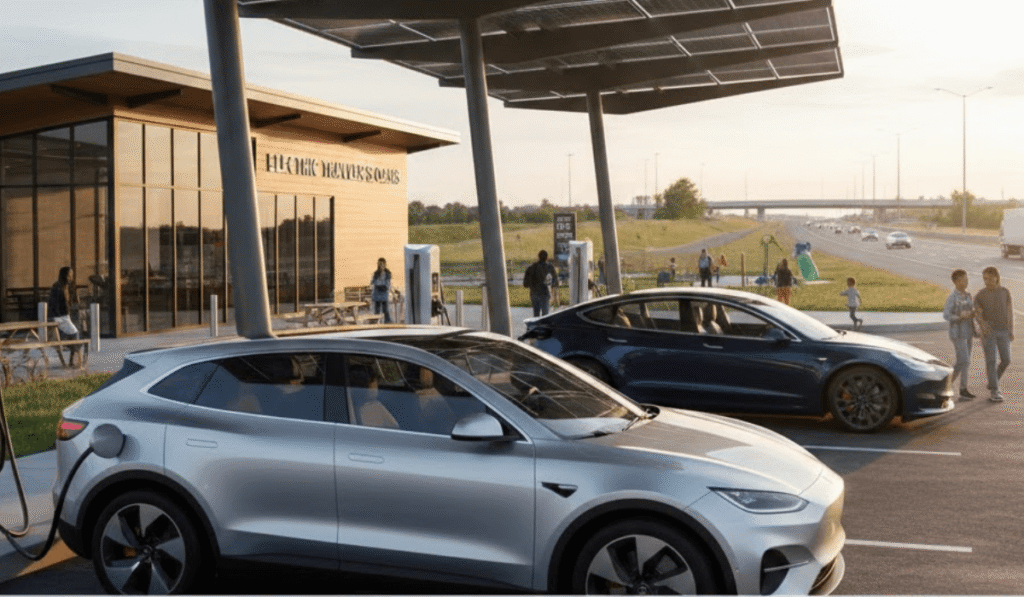
Something exciting is happening at America’s rest areas. Between the vending machines and the pet walk areas, a new piece of infrastructure is quietly showing up: EV charging stations. It’s still early days, but the rollout is accelerating fast, and for electric vehicle owners, the ability to charge at a highway rest area — for free or low cost, in a safe, public location — is genuinely changing what long-distance EV travel looks like. Here’s everything you need to know about planning a road trip around EV-equipped rest areas.
Why This Matters for EV Road Trippers
Range anxiety — the fear of running out of battery with nowhere to charge — is still one of the top concerns for people considering an electric vehicle. Charging infrastructure at highway rest areas directly addresses this. When you can pull off an interstate, plug in for 20 to 30 minutes while you use the restroom, grab a snack, and let the kids run around, EV travel starts to feel a lot less stressful and a lot more like any other road trip.
The federal government clearly agrees. The Bipartisan Infrastructure Law allocated $7.5 billion specifically for EV charging infrastructure, with a big chunk earmarked for highway corridors. States are actively competing for those funds, and rest areas are a primary deployment target.
Which States Are Leading the Way
California has been the most aggressive by far. The state has been adding DC fast chargers to Caltrans rest areas up and down I-5, Highway 99, and other major routes. Some California rest areas already have multiple chargers, and the state’s goal is to make EV charging as standard as a vending machine.
New York has invested heavily along the I-90 corridor and is expanding rapidly. The state’s EV corridor initiative aims to have chargers every 50 miles on major interstates — a goal that’s already partly achieved in many stretches.
Florida, Colorado, Washington, and Oregon are all making meaningful progress. Even traditionally slower-moving states in the Midwest and Southeast are beginning to install chargers at welcome centers and major rest areas, often as part of federal grant programs.
What Kind of Chargers Are at Rest Areas?
This varies, and it matters. Level 2 chargers (240V) are slower — they’ll add roughly 10 to 25 miles of range per hour of charging. They’re fine if you’re stopping for an hour or more, but not ideal for a quick 20-minute break.
DC fast chargers (Level 3) are what you want for a road trip stop. These can add 100 to 200 miles of range in 20 to 30 minutes, depending on your vehicle. More and more rest areas are installing these as the primary option, which makes a huge practical difference.
Tesla Superchargers have historically been separate from rest areas, but with Tesla’s network opening up to other vehicles and the company partnering with more public locations, you’re starting to see overlaps. Check before you go.
Apps and Tools for Planning EV-Friendly Stops
PlugShare is the gold standard for finding EV chargers — it’s crowd-sourced, frequently updated, and lets you filter by charger type, network, and compatibility with your vehicle. The map view makes route planning intuitive.
A Better Routeplanner (ABRP) is a route-planning tool designed specifically for EV drivers. Plug in your car model, your starting point, and destination, and it calculates optimal charging stops based on your battery capacity and driving speed. It integrates with PlugShare data and is genuinely impressive.
Tesla’s built-in navigation already does this automatically for Tesla owners. For everyone else, ABRP combined with PlugShare is the winning combination. And for finding rest areas specifically along your route, restareasnearme.com gives you the lay of the land before you leave home.
The Road Ahead
EV charging at rest areas is still a patchwork — excellent in some states, nearly nonexistent in others. But the trajectory is clear. Within the next few years, charging infrastructure at US rest areas will be dramatically more comprehensive. Manufacturers are building longer-range vehicles, charging speeds are improving, and federal money is flowing into exactly this kind of infrastructure.
The long-distance EV road trip that once felt like a logistical puzzle is becoming something genuinely accessible. The charging network is being built, stop by stop, and rest areas are at the heart of it.