
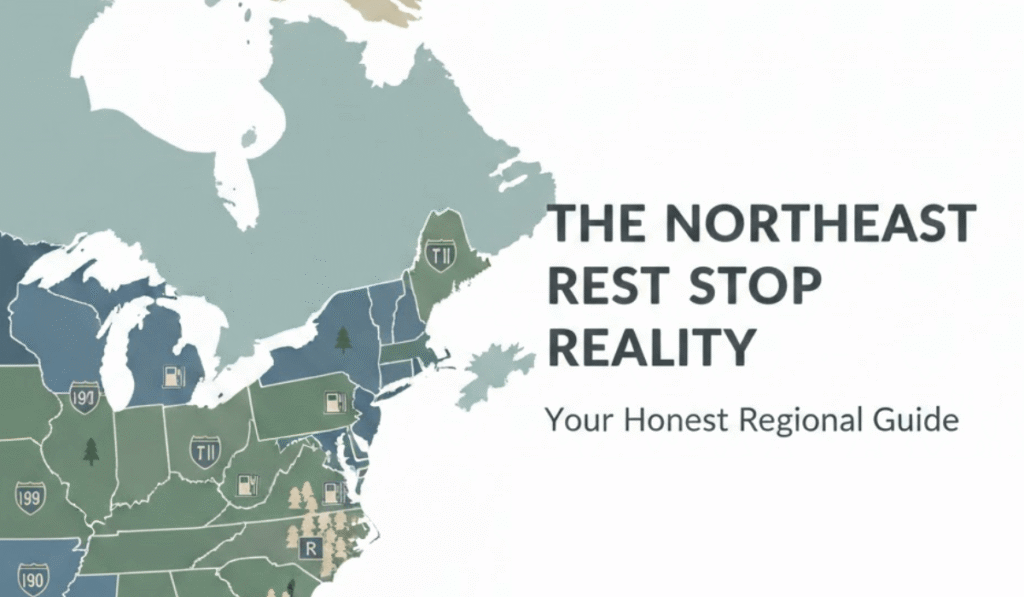
The Northeast is one of the most densely traveled regions in the country — and in some ways, one of the trickiest for rest area planning. The mix of toll roads, service plazas, older infrastructure, and highly variable state systems means what works in Virginia doesn’t necessarily apply in Connecticut. If you’re driving through New England or the Mid-Atlantic and you want to know where to stop, here’s your honest regional guide.
The Toll Road Reality: Service Plazas Instead of Rest Areas
A significant portion of Northeast highway driving happens on toll roads — the New Jersey Turnpike, the Pennsylvania Turnpike, the New York Thruway, the Massachusetts Turnpike, and the Maine Turnpike, among others. These roads operate on a different model: instead of free government rest areas, they have full-service plazas that include fuel, food, restrooms, and retail.
For drivers, this is actually quite convenient. Plazas are generally clean, well-lit, and spaced at reasonable intervals — usually 20 to 40 miles. Oasis, Sunoco, and various food vendors operate inside them. The trade-off is that you’re stopping at a commercial facility rather than a quiet government rest area, and the parking lots can get very busy during peak travel periods.
Massachusetts, Connecticut, and Rhode Island
These three small states can be covered relatively quickly, but traffic — especially around Boston, Hartford, and Providence — is consistently brutal at peak hours. Traditional rest areas are limited in this corridor; the toll road model dominates.
The Massachusetts Turnpike (I-90) has service plazas at Charlton, Blandford, and Natick. Connecticut’s I-95 has limited rest area options; knowing the exits with reliable gas stations in advance is more useful than hunting for official rest stops. Rhode Island is so compact that stopping in Providence for services is usually the most practical approach.
Maine, New Hampshire, and Vermont
Head north and the Northeast gets more rural and more rest-area-friendly. Maine’s Turnpike has decent plazas, and once you’re off the toll system, the state has traditional rest areas on I-95. The Maine Welcome Center just across the New Hampshire border is excellent — a proper introduction to Vacationland with helpful staff and good facilities.
New Hampshire and Vermont have more limited interstate infrastructure, but the highways that do exist — I-89, I-91, I-93 — have functional rest areas at reasonable intervals. Vermont’s approach to development means rest areas here often have genuine natural surroundings that feel distinctly different from urban-corridor stops.
Maryland, Delaware, and the I-95 Corridor
Maryland’s I-95 is served by the Maryland House and Chesapeake House service areas — full-service stops that are genuinely useful and well-maintained. Delaware is small enough to cross in under an hour, and the choice there is usually just to power through to Maryland or Pennsylvania.
Overall, the I-95 corridor from Washington DC to New York City is one of the most congested in the nation. Plan your stops for off-peak times when possible and use rest areas to get ahead of traffic rather than stopping when you’re in the thick of it.
Planning Is Essential in the Northeast
More than anywhere else in the country, the Northeast rewards advance planning for rest stops. The mix of toll plazas, traditional rest areas, and service gaps means knowing what’s ahead — especially if you’re driving overnight or with kids — makes a real difference. Use restareasnearme.com to map the Northeast section of your route before you go, and check the Thruway Authority, Pike, or Turnpike websites for current plaza status.