
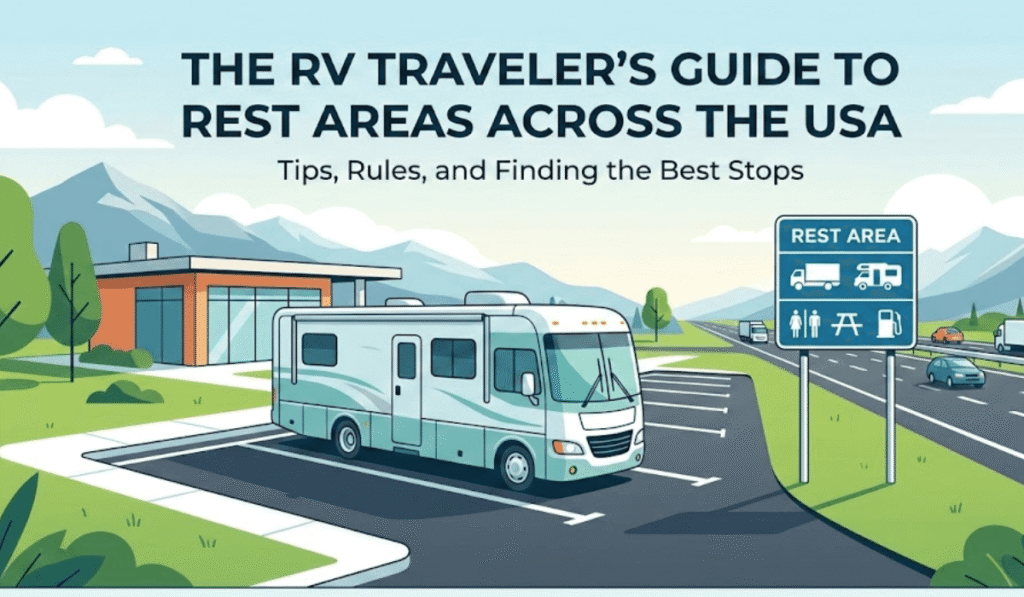
Pulling a 35-foot motorhome into a rest area is a different experience from parking a sedan. The turns are wider, the space requirements are bigger, and not every rest area is designed with you in mind. But with the right knowledge, rest areas can be genuinely useful stops for RV travelers — not just for quick breaks but as part of a smart overnight strategy. Here’s what every RV traveler should know before they pull off the interstate.
Are Rest Areas RV-Friendly?
Most are — but with caveats. Federal guidelines recommend that rest areas accommodate commercial vehicles, which means larger parking footprints are common at well-designed facilities. The challenge is that RV parking spots and truck parking spots are often in the same section, and during peak travel season, those lots fill up fast.
The best rest areas for RVs have pull-through spaces (no backing up required), wide turning radii, and clearly marked oversized vehicle sections. The worst have tight layouts designed for passenger cars, with curbs and light poles positioned in spots that turn a simple parking job into an anxiety spiral.
Before you pull in, look for the overhead clearance signs if you’re approaching covered areas, and always do a slow roll through the lot to assess spacing before you commit to a spot.
Dump Stations: The Real Question
One thing most rest areas don’t have is dump stations. If you need to empty your tanks, you’ll almost always need to plan for a different stop — RV parks, campgrounds, or truck stops with RV services. Pilot Flying J and Love’s both have dump stations at select locations, and the Sanidumps app or RV Parky app can help you locate them along your route.
Some state welcome centers and rest areas — particularly in the Mountain West and Southeast — do have dump stations, but they’re the exception. Don’t assume, and always check before you’re in an urgent situation.
Overnight Parking for RVs at Rest Areas
The same rules that apply to regular vehicles apply to RVs at rest areas: most states allow stays up to 8 to 10 hours, and while enforcement varies, you’re generally fine for an overnight stop.
For longer stays, RV parks are a better option — they have hookups, dump stations, and amenities that rest areas simply can’t match. But for a single overnight pause on a long travel day, a rest area with a spacious truck section does the job.
Look for rest areas that separate truck and RV parking clearly. Some facilities have specifically designated RV areas, which are more comfortable and less noisy than parking next to idling diesels all night.
Finding RV-Friendly Stops on Your Route
The RV Trip Wizard app and Campendium both have strong rest area features with crowd-sourced reviews from RV travelers specifically. You’ll find notes on lot size, surface type, noise levels, and whether overnight stays are enforced. These RV-specific reviews are far more useful than general travel app reviews when you’re behind the wheel of something large.
For pre-trip planning, use restareasnearme.com to identify rest areas along your route, then cross-reference with RV-specific apps to confirm which ones are spacious enough for your rig. A little homework before you roll beats a stressful arrival in a tight lot after dark.
The Bottom Line for RV Drivers
Rest areas can absolutely work for RV travelers, with the right expectations. Use them for breaks and short overnights. Plan dump stations separately. Choose facilities with truck-sized parking. And build your overall trip around a mix of rest areas and campgrounds rather than relying solely on either. The road is yours — the key is knowing what works for your specific rig and travel style.